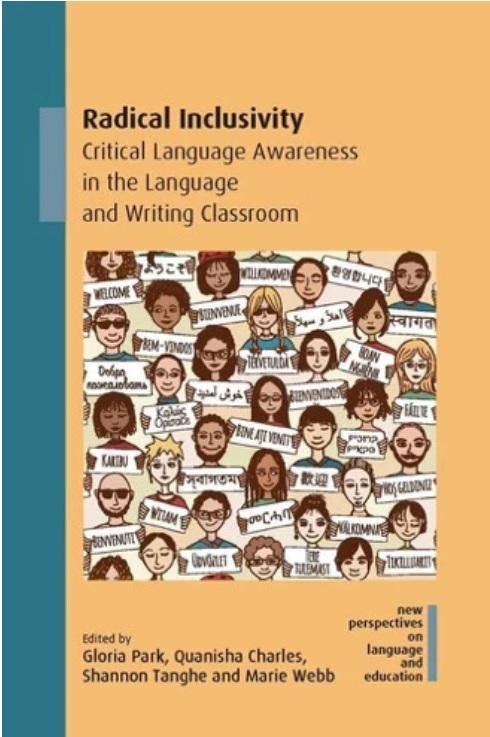
CATESOL Book Review: Radical Inclusivity: Critical Language Awareness in the Language and Writing Classroom by Gloria Park, Quanisha Charles, Shannon Tanghe and Marie Webb
02/22/2026
Michelle Skowbo
By Michelle Skowbo and Kara Mac Donald
Forward and Introduction
Shawna Shapiro and Shenika Hankerson
The forward begins by introducing critical language awareness (CLA). Key facets of CLA include:
radical inclusivity extends to the whole school environment and educational experience.
In the introduction, the writers describe their teaching and mentoring experiences and express their goals for making instruction and curriculum more reflective of participants' experiences. They also decry limited opportunities for sharing practices and bringing broad change, especially for teachers who are newer and/or less plugged into current western publishing communities. They argue that many language teachers at different career stages and in different parts of the world are taking creative steps to make their classrooms radically inclusive/ Though sharing, language education can become more supportive for students from a greater range of backgrounds.
Laura Aul and Shawna Shapiro
Laura Aul and Shawna Shapiro begin by explaining how radical inclusivity and critical language awareness can start with reading. Students should be informed about the relationship between power and language. Reading texts with a CLA lens is an important step in developing awareness of these dynamics, but secondary and post-secondary students need more strategies for advanced texts. Slower, mindful reading gives students space to become aware of their emotions and reflect on the connections they have to the ideas in the texts. Instructors can help students to notice how specific words and phrases build a writer's rhetorical approach.
Aul describes teaching freshman university students in ways that create opportunities to reflect on linguistic registers and dialects in different contexts. Her students analyze examples and read research by linguists to unpack assumptions about different types of written texts. They also learn the principles that guide western academic writing when introducing a topic and predictable patterns that can aid clarity.
Aul includes details of one particular activity. Students read Vershawn Ashanti Young's text on the benefits of blending different types of language use in the same text. They identify the rhetorical "moves" Young uses to make his argument, discovering that the rhetorical complexity of a text is not determined by how well it conforms to prescriptivist notions.
Fictional 'Truths' about Language: Using Creative Fiction for Radical Inclusion and Critical Language Awareness
Chapter 2: Fictional 'Truths' about Language: Using Creative Fiction for Radical Inclusion and Critical Language Awareness
Sean Oros
Sean Oros posits that monolingual students may not see the need for linguistic radical inclusion, but "creative fiction writing is a way for [them] to engage with CLA and develop greater language awareness and empathy" (84). Creative writing can promote CLA in several ways. Rich and plentiful examples are available from writers of creative fiction who are from marginalized groups. Additionally, linguistic "experimentation" is considered normal in this genre. Creative writing has the advantage of being enjoyable and engaging multiple linguistic and other creative skills.
Oros describes a two-week unit that he incorporated into a creative writing course offered at a university in rural Washington. Most students are not ELLs, but the final assignment is to write a short story that is "built on translingual negotiation" (92). To scaffold considering minority experiences, Oros starts the unit by having his students read pieces by language minorities.
The unit has multiple purposes: gaining creative experience by writing from the perspective of someone with a different background and learning to be more inclusive in real life with individuals from different backgrounds. The unit also includes optional anonymous pre and post surveys with questions related to CLA concepts.
In analyzing results of the pre and post unit survey on opinions on CLA, Oros found that some students improved their attitude toward CLA principles and shared that they used some of what they had learned for writing assignments in other classes. Others remained unreceptive to CLA principles. These differing opinions were also shared during class discussions. Oros concludes by affirming the value of CLA in creative writing to encourage students to consider and respect the perspectives and experiences of language minorities.
Chapter 3: Toward Radical Inclusivity in First Year Composition: A Lesson for CLA, Translingual Writing and Metacognitive Development
Sophia Minnillo
Sophia Minnillo begins the chapter by laying out the elements needed for radical inclusivity: CLA, translanguaging, and metacognitive practices, defining each in turn. She also includes contract-based grading as an inclusive teaching practice.
She goes on to describe teaching a specific writing lesson to a small, multicultural class of first-year university students. The class read and watched pieces that provided examples of translanguaging. As a class, they defined and came up with examples of key terms and individually did freewrites that "include[d] as much language diversity as possible" (118). Students then read and explained the language choices of their freewrites to a partner.
Minnillo sequenced her curriculum so that her lesson would precede her students’ first peer feedback class day: a time when students may "[reinforce] standard language ideologies through their feedback and revising practices" (112). In giving feedback, her students wrote that they appreciated gaining the terminology to describe and the space to use and show pride in their multilingual backgrounds and experiences.
Minnillo argues that it is important for students, especially those who are uncomfortable with a lesson that challenges the privileges of standard academic English instruction, to gain meaningful practice using translanguaging techniques themselves. The author acknowledges that the unit may be met with resistance but emphasizes the benefits: greater inclusion and greater awareness of one's thought processes and attitudes during writing.
Chapter 4: Radically Inclusive Teaching: A Lesson Utilizing the Learning about Written Languages (LaWL) Approach
Marie Webb
Marie Webb describes teaching international students who are preparing for credit-level courses. She describes a lesson that she uses to make her students aware of the gap between the celebration of diversity that universities avow and the racism from the past and present that has existed in academic communities. The focus of the lesson is social justice and the product is a paper that students write about inequity and diversity in education and places of employment in the United States. As they read about inequalities, especially racism, from an older text, they learn relevant vocabulary and compare it to more current terminology. The materials that the students use to prepare for the class meeting include a video that presents key vocabulary, texts that describe issues of inequality and discrimination in the United States, a video lecture by the author, and style guides to help writers use inclusive language and avoid offensive language. After giving the class time to discuss and clarify concepts related to language and status, the class analyzes an older text. Students get into groups and discuss "the acceptability of certain words and phrases in the passage" (136). Working together, students used an online collaboration tool to answer questions about previous exposure to social justice concepts, experiences that they have had or heard about with discrimination, and reactions to the reading. The homework for the next class is to listen to a podcast describing the shift from using POC to BIPOC.
Webb noted that when she taught this lesson, some students felt empowered by the lesson while others found the problems they were learning about unsettling. One student expressed concerns over being able to incorporate inclusive language appropriately. Webb used this opportunity to share her own challenges to try to educate herself about these topics.
Chapter 5: Critical Language Awareness and Translingual Pedagogies in the Language Teacher Education Classroom: An Enactment
Havva Zorluel Ozer
Havva Zorluel Ozer begins the chapter by describing her early experiences learning English in school in Turkey, where the focus was on academic English. She also learned the lyrics of Black Eyed Peas songs, which had words that weren't "standard" enough to be acceptable use in her assignments. As an adult, she sees the racial implications of what she was taught in school.
Ozer advocates the need for English language teacher preparation to "explicitly be radically inclusive" (147) by directly challenging status quo ideas about "correct" English that perpetuate racial discrimination. While some academic institutions in counties where English is the dominant language include translingualism instruction, institutions outside of these countries are not engaging in the translingualism movement and continue to give preservice EFL teachers a much more prescriptivist training.
She challenges the idea that prescriptivism in EFL contexts is inevitable and describes teaching an introductory linguistics course to a class of university undergraduate students preparing to become English language teachers. Her reason for bringing CLA and translingualism learning principles into the preservice language classroom is partly to raise awareness of how language is intertwined with social justice and helping her learners "appreciate language and language differences in communication" (153).
Before class, students read several chapters on speaking skills that introduced varieties of English. At the start of class time, Ozer asked the class to write responses to questions about the type of English that they wanted to use and their attitudes toward slang. The class watched several movie clips that featured characters using nonstandard dialects of English and read scripts of these segments aloud. Ozer provided eight types of "language subordination processes," (154) or techniques for maintaining standard dialect supremacy, to the class and asked them to work together to find these techniques in the movie clips.
In preparation for the next class period, they class read about CLA concepts in writing. The class read examples of translanguaging and the “Students' Right to Their Own Language" resolution (National Council of Teachers of English, 1974). Ozer did note that some students disagreed with each other during a class discussion to the point that the atmosphere was uncomfortable; however, she was able to use this situation as a teachable moment for her students. Luckily, she takes time to set expectations for reasonable behavior and advises teachers to do the same. After the class period, students create cartoons with characters who use different dialects. Ozer explains how these activities helped her students to reconsider prescriptivist notions and demonstrate understanding of how language subordination can show up.
Chapter 6: Linguistic Landscapes, Discussion Forums, and Conscientizacão: A Pedagogical Ensemble to Address Linguistic Glottonormativity in Language Teacher Education
Silvia Melo-Pfeifer and Vander Tavares
Inspired by Paolo Freire's concept of Conscientização, Silvia Melo-Pfeifer and Vander Tavares work to draw awareness of oppressor/oppressed dynamics as seen through language choices in public spaces: linguistic landscapes. Melo-Pfeifer and Tavares explain that comparing a community's signs to the languages spoken there can show exclusion. They also note that if negative signs include a language, there could be negative attitudes towards speakers of that language.
During the pandemic, future language teachers from universities in Hamburg, Germany and Sydney, Australia were asked to do demographic and migration research on their cities and compare this information to their "linguistic landscapes." Students were then put into groups across the two universities, and the groups worked together to make a unit plan that would address multilingualism. The student teachers began the unit by sharing photos that "depicted multilingualism" (192) on their online discussion board.
The authors conclude by affirming the benefits of asking future language teachers to consider Freire's pedagogical theories, problematic aspects of monolingual ideologies, and real-life dynamics within communities. Linguistic landscapes are rich sources of data, and instructors can push students to find where these ideas and examples intersect.
Chapter 7: Critical Language Awareness in Language Teacher Education: How Can Critical Autoethnographic Narrative Help?
Bedrettin Yazan, Ceren Kocaman and Kristen Lindahl
The chapter begins with a review of literature on identity in language classrooms. The authors state that to take a critical and inclusive approach, language teachers must learn about power, language, and identity; additionally, they must examine their own identities. In order to encourage this learning, the authors developed activities in which students built up a critical autoethnographic narrative (CAN). The authors posit that it is critical for language teachers to become aware of how language teaching is enmeshed in politics and history. Their students attended graduate programs in the United States and Germany. The classes first looked at examples of autoethnographies, considered the benefits, and analyzed connections to language learning. The students were given guiding questions when they started writing their critical autoethnographic narratives, and they received feedback from both peers and instructors. These narratives were not static: several weeks in, they created concept maps to help them refine their writing.
Bedrettin emphasized the need to space the components of the narrative out because although students could connect language to identity quickly, it took longer for their other identities to "surface" (221) fully. The authors noted that their graduate students experienced some discomfort with the genre of CANs because the texts were both research writing and personal narratives. They also noted that it was challenging to know how to proceed when students shared difficult personal moments from their lives or when students clung to ideologies that would perpetuate marginalizing practices.
All of the authors felt that the project helped their graduate students become more motivated to consider their students' identities in a more inclusive, comprehensive, and sensitive way. They also found that their graduate students questioned the way language education traditionally regards native versus non-native speaker distinctions.
Chapter 8: Increasing Pre-service ESOL Teachers' Critical Language Awareness through Dialectical Variation
Brian Hibbs
Brian Hibbs begins the chapter by providing several definitions of inclusion in education and then highlights the commonality: "efforts should be made to include those who have been...marginalized by traditional policies and procedures" (237). He posits that in order to make an educational environment inclusive, educators must deviate from norms; also, teachers and students must gain critical language awareness. Student teachers and current teachers need to appreciate and learn to celebrate the different cultural and linguistic knowledge that their students have.
To this end, Hibbs shares a lesson with five modules with several objectives: Preservice teachers at a university in the United States identify dialect differences and develop inclusion strategies, focusing on ways to make variance from the privileged language and dialect an asset instead of a deficit. Students learn about prescriptivism versus descriptivism and linguistic features of major dialects of American English. They then do linguistic analyses of different dialects and read articles on how nonstandard dialects are as consistent and linguistically valid as dialects accepted as standard; these articles also address concepts of identity and belonging. They read about tasks they can incorporate into their own classrooms so that their students can also appreciate dialect variation.
Two sections of students were surveyed at the end of the course, and overall they seemed to find the unit helpful. Some students expressed a lack of confidence in their understanding of some of the linguistic concepts, so ample introduction is necessary.
The author concludes by expressing his wish that preparation programs for ESOL teachers will emphasize inclusive approaches over "hegemonic ideologies" (258).
Chapter 9: Radical Inclusivity in Language Teacher Education: Addressing Linguistic Bias and Linguistic Discrimination
Shannon Tanghe
Shannon Tanghe begins her chapter by defining linguicism: discrimination related to language. Tanghe posits that its practice is not always even a conscious choice, it is a pervasive way that power dynamics are reinforced. Tanghe acknowledges that language can both promote and discourage discrimination, and so radical inclusion must be a component of critical language awareness. As in previous chapters in this section, the author is an instructor of a teacher preparation course at a university. This course focuses on preparing teachers to work with immigrants, including refugees, in urban schools. The course's objectives include identifying biases, types of macro and micro discrimination, and best practices for promoting equity in communities.
One of the purposes of the lesson is for student teachers to "reflect on their privileges" as these relate to their approaches in the classroom and make adjustments so that linguistically-diverse students will feel welcome" (269-270). Students prepare by reading about privilege and doing a partner discussion activity with a mix of relatively neutral and more emotionally-charged questions. Students then work together to write their definitions of privilege.
The class posts on a Padlet their reactions to readings that address ways privilege can seem invisible and how intersection affects identity. They also think of ways that immigrants often lack these privileges. The next part of the unit is a simulation in which some students are given privileges and others are treated in negative ways. The author offers specific and poignant ways in which linguistic exclusion might manifest in a classroom.
Tanghe noted that she has taught this topic multiple times and hearing about the experiences of her students and their families has deepened her understanding of linguicism. Students shared ways that they experienced or, in some cases, perpetuated linguistic discrimination. The writer encourages all teachers to consider drawing on parts of this lesson but cautions that the simulation may not be appropriate in all classroom settings. It should only be done after the teacher and students have gotten to know each other and the teacher has established a way for students to set boundaries if certain aspects of the activity are too intense for them. Additionally, teachers need to begin by examining their own identities and moving forward in ways that are authentic and beneficial to both them and their students.
Chapter 10: Metrolingual Maps: Exploring Multilingual Practice in the Community
Nils Olov Fors
Nils Olov Fors broadens the discussion’s commitment to critical language awareness by shifting attention from classroom-bound notions of language to lived, community-based multilingual practices. Fors introduces “metrolingual maps” as a pedagogical and analytic tool that invites students to document, visualize, and interpret multilingual signs, interactions, and linguistic repertoires in urban spaces. Drawing on sociolinguistic and spatial theory, the chapter challenges monolingual and standardized language ideologies by highlighting fluid, dynamic, hybrid language use in everyday contexts, such as in restaurants, markets, transit systems, and neighborhood signage. Through mapping, students come to see language not as a fixed system tied to nation, community, or ethnicity, but as dynamic social practice embedded in power relations, migration histories, and economic networks.
Fors positions metrolingual mapping as both inquiry and intervention processes. The activity of mapping encourages students to question whose languages are visible or erased in public space/s and how linguistic landscapes reflect broader inequalities. By moving beyond deficit frameworks, the chapter advocates for recognizing multilingual repertoires as resources rather than problems or shortfalls. However, while the pedagogical framework is generative and adaptable, its implementation may require substantial scaffolding to ensure students move from description to critical analysis. The chapter makes a strong contribution to the book’s overall mission towards an inclusivity framework by offering a concrete methodology that links critical language awareness to community engagement, spatial literacy, and transformative classroom practice.
Chapter 11: The Dialogic Griot: Advocating for Communities through Story Mapping
Valerie A. Gray
Valerie A. Gray examines how radical inclusivity must move beyond rhetorical commitments toward sustained pedagogical transformation. She highlights how language and writing classrooms often reproduce normative assumptions about “standard” language, academic discourse, and participation. Through classroom-based examples, she explains how seemingly neutral instructional practices can marginalize students whose linguistic repertoires, identities, or cultural practices fall outside mainstream norms and expectations. The chapter calls for educators to question how power is present in curriculum design, assessment, and classroom interaction.
It offers concrete pedagogical strategies that reposition students’ multilingual and multidialectal resources as academic assets rather than deficits. The author advocates for instructional spaces that foster dialogic engagement, reflexivity, and shared authority, encouraging teachers to design learning experiences that validate students’ lived experiences and linguistic identities. In doing so, like other chapters, it highlights that radical inclusivity requires not only openness to diversity but a deliberate restructuring of classroom norms, knowledge and discursive frameworks, and assessment practices to cultivate equitable participation and belonging.
Chapter 12: Exploring NCTE Position Statements as Opportunities for Critical Awareness and Inclusivity
Kristene R. McClure and Rodrigo Martinez
Kristene R. McClure and Rodrigo Martinez explore the complexity of sustaining inclusive pedagogies in contexts still governed by standardized curricula, assessment mandates, and deeply entrenched notions of “academic” language. In doing so, they position radical inclusivity not as an instructional add-on, but as a transformative stance that requires structural awareness and ethical commitment. Drawing on practitioner inquiry, reflective narratives, or classroom-based examples, they illustrate how educators navigate tensions between institutional expectations and socially just teaching goals. They share moments of friction, where multilingual, multidialectal, and culturally diverse student voices challenge dominant norms and analyze how such moments can become sites of pedagogical growth rather than deficit framing. The discussion emphasizes reflexivity, collaboration, and coalition-building as necessary conditions for sustaining inclusive practices over time.
They move the focus from individual classroom practice to collective transformation, emphasizing radical inclusivity cannot be achieved or sustained in isolation. It requires communities of practice where educators collaborate, change restrictive norms, and innovate together. Partnerships with multilingual communities and opportunities for shared investment reposition students as co-constructors of knowledge rather than passive recipients. Through this collaborative lens, inclusivity becomes grounded in shared responsibility.
By valuing multimodal literacies and diverse modes of expression, the authors challenge entrenched hierarchies of academic knowledge and expand what counts as legitimate scholarly participation. In doing so, assessment becomes a site of equity rather than exclusion. Additionally, they highlight how inclusivity is an ongoing process rather than a fixed achievement or state. The authors argue that educators must continually question whose knowledge is legitimized, whose voices are centered and valued and how assessment practices either constrain or expand participation.
Chapter 13: Trauma-Informed Practice in a Radically Inclusive Classroom
Elizabeth S. Coleman
Elizabeth S. Coleman addresses the framework of radical inclusivity by centering trauma-informed pedagogy as an essential component of equitable language and writing instruction. She argues that linguistic diversity, migration histories, racialized experiences, and educational marginalization often intersect with trauma in ways that shape students’ classroom participation and academic performance. Coleman positions trauma-informed practice not as a therapeutic add-on but as a pedagogical stance grounded in empathy, safety, predictability, and relational trust. In doing so, she reframes inclusivity as inseparable from attentiveness to students’ emotional and embodied experiences.
Drawing on trauma theory and classroom-based reflection, she outlines concrete strategies for creating learning environments that minimize retraumatization, while maintaining rigorous academic expectations. Coleman emphasizes transparency in assessment, flexibility in participation structures, and the cultivation of consistent routines that support student agency. She connects trauma-informed practice to critical language awareness, demonstrating how deficit perspectives can compound harm for linguistically and culturally marginalized learners. Through addressing relational accountability and reflective teaching, the chapter highlights the ethical responsibilities educators bear in shaping classroom climates. She also argues that inclusivity must attend not only to language ideologies and structural inequities, but also to the lived, affective dimensions of student experience.
Chapter 14: Sparking Critical Awareness of Language Variation, Accent and Ideology through an Allyship Approach
Vance Schaefer and Tamara Warhol
Vance Schaefer and Tamara Warhol extend the volume’s commitment to radical inclusivity by focusing on language variation, accent, and the ideologies that shape how these are perceived in educational spaces. They explore deeply embedded assumptions about “standard” language and accent neutrality, arguing that such norms are neither linguistically natural nor socially neutral, but rather rooted in histories of power, racialization, and institutional gatekeeping. By foregrounding accent discrimination and linguistic prejudice, the authors highlight how everyday classroom practices can inadvertently reinforce hierarchies that marginalize multilingual speakers and speakers of stigmatized dialects. The chapter situates critical language awareness within a broader social justice framework, emphasizing that confronting language ideology is central to building radically inclusive classrooms.
A key contribution of the chapter is its framing of allyship as both a pedagogical strategy and an ethical orientation. Schaefer and Warhol propose that educators and students can actively position themselves as allies in challenging accent bias and linguistic discrimination. Through classroom-based activities, reflective assignments, and critical discussions, the authors illustrate how learners can examine their own linguistic assumptions and recognize the sociopolitical forces that privilege certain accents over others. Rather than merely celebrating linguistic diversity in abstract terms, the allyship approach encourages concrete action reducing discriminatory discourse, advocating for equitable assessment practices, and supporting peers whose language practices are devalued. This shift from awareness to action underscores the chapter’s practical orientation.
The chapter also addresses the emotional and relational dimensions of this work. Conversations about accent and ideology can surface discomfort, resistance, and vulnerability, particularly in contexts where “standard language” norms are strongly institutionalized. Schaefer and Warhol acknowledge these tensions while maintaining that discomfort can be productive when guided by structured reflection and community accountability. By linking allyship to critical language awareness, the authors demonstrate how inclusivity requires both intellectual critique and interpersonal commitment. Like in other chapters, they highlight radical inclusivity demands not only recognition of linguistic diversity but active participation in the dismantling of the ideologies that sustain inequity in language education.
Chapter 15: Partnering with Students with Disabilities: Informed Practices and Support Networks
Jessica Kent and Marie Satya McDonough
Jessica Kent and Marie Satya McDonough expand the framework of radical inclusivity to students with disabilities, positioning them as active partners in the learning process rather than passive recipients of accommodation. They critique deficit-oriented and compliance-driven approaches to disability support, arguing that such models often reduce inclusion to procedural accommodation rather than genuine collaboration. Instead, the authors advocate for an informed, relational approach grounded in accessibility, shared decision-making, and respect for students’ lived expertise. By reframing disability through a social and ecological lens, they situate inclusive practice within broader institutional and ideological structures that shape access, participation, and belonging.
Drawing on practitioner experiences and classroom practices, the authors outline strategies for partnering effectively with students with disabilities. These include proactive communication, transparent course design, flexible participation structures, and the integration of universal design principles. They emphasize that accessibility should not be retrofitted after barriers emerge but embedded from the outset through intentional planning. Kent and McDonough also underscore the importance of support networks where there is collaboration among faculty, disability services professionals, administrators, and students themselves to create sustainable systems of care and advocacy. Such networks distribute responsibility for inclusion beyond the individual instructor, reinforcing the collective nature of radically inclusive education.
These partnerships are both pedagogical and ethical. By recognizing students with disabilities as co-constructors of knowledge and contributors to classroom innovation, Kent and McDonough challenge hierarchical assumptions about expertise and authority. Through emphasis on informed practice and collaborative networks, the authors offer a pragmatic yet principled vision of accessibility as integral, not supplementary, to equitable language and writing education.
In the Afterword, Park, Charles, Tanghe, and Webb each offer a section to complete the volume that is reflective and forward-looking. They synthesize the central themes of radical inclusivity, critical language awareness, and pedagogical responsibility. Rather than offering a simple recap, the editors frame the collection as an ongoing conversation, one that calls educators, scholars, and institutions to sustained engagement. They emphasize that radical inclusivity is not a static framework or a checklist of strategies, but a shared ethical commitment rooted in dialogue, reflexivity, and collective accountability. By revisiting the contributions of the individual chapters, the Afterword highlights how issues of language, power, identity, disability, trauma, and institutional constraint intersect within contemporary language and writing classrooms.
Michelle Skowbo
Radical Inclusivity: Critical Language Awareness in the Language and Writing Classroom by Gloria Park, Quanisha Charles, Shannon Tanghe and Marie Webb
By Michelle Skowbo and Kara Mac Donald
Introduction
The text Radical Inclusivity: Critical Language Awareness in the Language and Writing Classroom challenges status quo approaches to language and writing teaching by providing examples of alternatives. The editors have invited educators to share their strategies for radical inclusivity. Some instructors describe lessons in which their objectives align with principles of radical inclusivity and critical language awareness. They share the theoretical foundations, classroom context, lesson objectives and activities, and reflections on the lessons. Other educators give broader ways to engage universities and communities in the practice of radical inclusivity.Forward and Introduction
Shawna Shapiro and Shenika Hankerson
The forward begins by introducing critical language awareness (CLA). Key facets of CLA include:
- Access: How language works (and power dynamics)
- Agency: How to use language in an active and meaningful way
- Asset: How to appreciate and honor students’ L1 background
- Advocacy: How to promote justice (27-28).
radical inclusivity extends to the whole school environment and educational experience.
In the introduction, the writers describe their teaching and mentoring experiences and express their goals for making instruction and curriculum more reflective of participants' experiences. They also decry limited opportunities for sharing practices and bringing broad change, especially for teachers who are newer and/or less plugged into current western publishing communities. They argue that many language teachers at different career stages and in different parts of the world are taking creative steps to make their classrooms radically inclusive/ Though sharing, language education can become more supportive for students from a greater range of backgrounds.
Part 1: What does radical inclusivity look like in the preparation of undergraduate writers?
Chapter 1: CLA and ReadingLaura Aul and Shawna Shapiro
Laura Aul and Shawna Shapiro begin by explaining how radical inclusivity and critical language awareness can start with reading. Students should be informed about the relationship between power and language. Reading texts with a CLA lens is an important step in developing awareness of these dynamics, but secondary and post-secondary students need more strategies for advanced texts. Slower, mindful reading gives students space to become aware of their emotions and reflect on the connections they have to the ideas in the texts. Instructors can help students to notice how specific words and phrases build a writer's rhetorical approach.
Aul describes teaching freshman university students in ways that create opportunities to reflect on linguistic registers and dialects in different contexts. Her students analyze examples and read research by linguists to unpack assumptions about different types of written texts. They also learn the principles that guide western academic writing when introducing a topic and predictable patterns that can aid clarity.
Aul includes details of one particular activity. Students read Vershawn Ashanti Young's text on the benefits of blending different types of language use in the same text. They identify the rhetorical "moves" Young uses to make his argument, discovering that the rhetorical complexity of a text is not determined by how well it conforms to prescriptivist notions.
Fictional 'Truths' about Language: Using Creative Fiction for Radical Inclusion and Critical Language Awareness
Chapter 2: Fictional 'Truths' about Language: Using Creative Fiction for Radical Inclusion and Critical Language Awareness
Sean Oros
Sean Oros posits that monolingual students may not see the need for linguistic radical inclusion, but "creative fiction writing is a way for [them] to engage with CLA and develop greater language awareness and empathy" (84). Creative writing can promote CLA in several ways. Rich and plentiful examples are available from writers of creative fiction who are from marginalized groups. Additionally, linguistic "experimentation" is considered normal in this genre. Creative writing has the advantage of being enjoyable and engaging multiple linguistic and other creative skills.
Oros describes a two-week unit that he incorporated into a creative writing course offered at a university in rural Washington. Most students are not ELLs, but the final assignment is to write a short story that is "built on translingual negotiation" (92). To scaffold considering minority experiences, Oros starts the unit by having his students read pieces by language minorities.
The unit has multiple purposes: gaining creative experience by writing from the perspective of someone with a different background and learning to be more inclusive in real life with individuals from different backgrounds. The unit also includes optional anonymous pre and post surveys with questions related to CLA concepts.
In analyzing results of the pre and post unit survey on opinions on CLA, Oros found that some students improved their attitude toward CLA principles and shared that they used some of what they had learned for writing assignments in other classes. Others remained unreceptive to CLA principles. These differing opinions were also shared during class discussions. Oros concludes by affirming the value of CLA in creative writing to encourage students to consider and respect the perspectives and experiences of language minorities.
Chapter 3: Toward Radical Inclusivity in First Year Composition: A Lesson for CLA, Translingual Writing and Metacognitive Development
Sophia Minnillo
Sophia Minnillo begins the chapter by laying out the elements needed for radical inclusivity: CLA, translanguaging, and metacognitive practices, defining each in turn. She also includes contract-based grading as an inclusive teaching practice.
She goes on to describe teaching a specific writing lesson to a small, multicultural class of first-year university students. The class read and watched pieces that provided examples of translanguaging. As a class, they defined and came up with examples of key terms and individually did freewrites that "include[d] as much language diversity as possible" (118). Students then read and explained the language choices of their freewrites to a partner.
Minnillo sequenced her curriculum so that her lesson would precede her students’ first peer feedback class day: a time when students may "[reinforce] standard language ideologies through their feedback and revising practices" (112). In giving feedback, her students wrote that they appreciated gaining the terminology to describe and the space to use and show pride in their multilingual backgrounds and experiences.
Minnillo argues that it is important for students, especially those who are uncomfortable with a lesson that challenges the privileges of standard academic English instruction, to gain meaningful practice using translanguaging techniques themselves. The author acknowledges that the unit may be met with resistance but emphasizes the benefits: greater inclusion and greater awareness of one's thought processes and attitudes during writing.
Chapter 4: Radically Inclusive Teaching: A Lesson Utilizing the Learning about Written Languages (LaWL) Approach
Marie Webb
Marie Webb describes teaching international students who are preparing for credit-level courses. She describes a lesson that she uses to make her students aware of the gap between the celebration of diversity that universities avow and the racism from the past and present that has existed in academic communities. The focus of the lesson is social justice and the product is a paper that students write about inequity and diversity in education and places of employment in the United States. As they read about inequalities, especially racism, from an older text, they learn relevant vocabulary and compare it to more current terminology. The materials that the students use to prepare for the class meeting include a video that presents key vocabulary, texts that describe issues of inequality and discrimination in the United States, a video lecture by the author, and style guides to help writers use inclusive language and avoid offensive language. After giving the class time to discuss and clarify concepts related to language and status, the class analyzes an older text. Students get into groups and discuss "the acceptability of certain words and phrases in the passage" (136). Working together, students used an online collaboration tool to answer questions about previous exposure to social justice concepts, experiences that they have had or heard about with discrimination, and reactions to the reading. The homework for the next class is to listen to a podcast describing the shift from using POC to BIPOC.
Webb noted that when she taught this lesson, some students felt empowered by the lesson while others found the problems they were learning about unsettling. One student expressed concerns over being able to incorporate inclusive language appropriately. Webb used this opportunity to share her own challenges to try to educate herself about these topics.
Part 2: What Does Radical Inclusivity Look Like in the Preparation of Language and Writing Teachers?
Chapter 5: Critical Language Awareness and Translingual Pedagogies in the Language Teacher Education Classroom: An Enactment
Havva Zorluel Ozer
Havva Zorluel Ozer begins the chapter by describing her early experiences learning English in school in Turkey, where the focus was on academic English. She also learned the lyrics of Black Eyed Peas songs, which had words that weren't "standard" enough to be acceptable use in her assignments. As an adult, she sees the racial implications of what she was taught in school.
Ozer advocates the need for English language teacher preparation to "explicitly be radically inclusive" (147) by directly challenging status quo ideas about "correct" English that perpetuate racial discrimination. While some academic institutions in counties where English is the dominant language include translingualism instruction, institutions outside of these countries are not engaging in the translingualism movement and continue to give preservice EFL teachers a much more prescriptivist training.
She challenges the idea that prescriptivism in EFL contexts is inevitable and describes teaching an introductory linguistics course to a class of university undergraduate students preparing to become English language teachers. Her reason for bringing CLA and translingualism learning principles into the preservice language classroom is partly to raise awareness of how language is intertwined with social justice and helping her learners "appreciate language and language differences in communication" (153).
Before class, students read several chapters on speaking skills that introduced varieties of English. At the start of class time, Ozer asked the class to write responses to questions about the type of English that they wanted to use and their attitudes toward slang. The class watched several movie clips that featured characters using nonstandard dialects of English and read scripts of these segments aloud. Ozer provided eight types of "language subordination processes," (154) or techniques for maintaining standard dialect supremacy, to the class and asked them to work together to find these techniques in the movie clips.
In preparation for the next class period, they class read about CLA concepts in writing. The class read examples of translanguaging and the “Students' Right to Their Own Language" resolution (National Council of Teachers of English, 1974). Ozer did note that some students disagreed with each other during a class discussion to the point that the atmosphere was uncomfortable; however, she was able to use this situation as a teachable moment for her students. Luckily, she takes time to set expectations for reasonable behavior and advises teachers to do the same. After the class period, students create cartoons with characters who use different dialects. Ozer explains how these activities helped her students to reconsider prescriptivist notions and demonstrate understanding of how language subordination can show up.
Chapter 6: Linguistic Landscapes, Discussion Forums, and Conscientizacão: A Pedagogical Ensemble to Address Linguistic Glottonormativity in Language Teacher Education
Silvia Melo-Pfeifer and Vander Tavares
Inspired by Paolo Freire's concept of Conscientização, Silvia Melo-Pfeifer and Vander Tavares work to draw awareness of oppressor/oppressed dynamics as seen through language choices in public spaces: linguistic landscapes. Melo-Pfeifer and Tavares explain that comparing a community's signs to the languages spoken there can show exclusion. They also note that if negative signs include a language, there could be negative attitudes towards speakers of that language.
During the pandemic, future language teachers from universities in Hamburg, Germany and Sydney, Australia were asked to do demographic and migration research on their cities and compare this information to their "linguistic landscapes." Students were then put into groups across the two universities, and the groups worked together to make a unit plan that would address multilingualism. The student teachers began the unit by sharing photos that "depicted multilingualism" (192) on their online discussion board.
The authors conclude by affirming the benefits of asking future language teachers to consider Freire's pedagogical theories, problematic aspects of monolingual ideologies, and real-life dynamics within communities. Linguistic landscapes are rich sources of data, and instructors can push students to find where these ideas and examples intersect.
Chapter 7: Critical Language Awareness in Language Teacher Education: How Can Critical Autoethnographic Narrative Help?
Bedrettin Yazan, Ceren Kocaman and Kristen Lindahl
The chapter begins with a review of literature on identity in language classrooms. The authors state that to take a critical and inclusive approach, language teachers must learn about power, language, and identity; additionally, they must examine their own identities. In order to encourage this learning, the authors developed activities in which students built up a critical autoethnographic narrative (CAN). The authors posit that it is critical for language teachers to become aware of how language teaching is enmeshed in politics and history. Their students attended graduate programs in the United States and Germany. The classes first looked at examples of autoethnographies, considered the benefits, and analyzed connections to language learning. The students were given guiding questions when they started writing their critical autoethnographic narratives, and they received feedback from both peers and instructors. These narratives were not static: several weeks in, they created concept maps to help them refine their writing.
Bedrettin emphasized the need to space the components of the narrative out because although students could connect language to identity quickly, it took longer for their other identities to "surface" (221) fully. The authors noted that their graduate students experienced some discomfort with the genre of CANs because the texts were both research writing and personal narratives. They also noted that it was challenging to know how to proceed when students shared difficult personal moments from their lives or when students clung to ideologies that would perpetuate marginalizing practices.
All of the authors felt that the project helped their graduate students become more motivated to consider their students' identities in a more inclusive, comprehensive, and sensitive way. They also found that their graduate students questioned the way language education traditionally regards native versus non-native speaker distinctions.
Chapter 8: Increasing Pre-service ESOL Teachers' Critical Language Awareness through Dialectical Variation
Brian Hibbs
Brian Hibbs begins the chapter by providing several definitions of inclusion in education and then highlights the commonality: "efforts should be made to include those who have been...marginalized by traditional policies and procedures" (237). He posits that in order to make an educational environment inclusive, educators must deviate from norms; also, teachers and students must gain critical language awareness. Student teachers and current teachers need to appreciate and learn to celebrate the different cultural and linguistic knowledge that their students have.
To this end, Hibbs shares a lesson with five modules with several objectives: Preservice teachers at a university in the United States identify dialect differences and develop inclusion strategies, focusing on ways to make variance from the privileged language and dialect an asset instead of a deficit. Students learn about prescriptivism versus descriptivism and linguistic features of major dialects of American English. They then do linguistic analyses of different dialects and read articles on how nonstandard dialects are as consistent and linguistically valid as dialects accepted as standard; these articles also address concepts of identity and belonging. They read about tasks they can incorporate into their own classrooms so that their students can also appreciate dialect variation.
Two sections of students were surveyed at the end of the course, and overall they seemed to find the unit helpful. Some students expressed a lack of confidence in their understanding of some of the linguistic concepts, so ample introduction is necessary.
The author concludes by expressing his wish that preparation programs for ESOL teachers will emphasize inclusive approaches over "hegemonic ideologies" (258).
Chapter 9: Radical Inclusivity in Language Teacher Education: Addressing Linguistic Bias and Linguistic Discrimination
Shannon Tanghe
Shannon Tanghe begins her chapter by defining linguicism: discrimination related to language. Tanghe posits that its practice is not always even a conscious choice, it is a pervasive way that power dynamics are reinforced. Tanghe acknowledges that language can both promote and discourage discrimination, and so radical inclusion must be a component of critical language awareness. As in previous chapters in this section, the author is an instructor of a teacher preparation course at a university. This course focuses on preparing teachers to work with immigrants, including refugees, in urban schools. The course's objectives include identifying biases, types of macro and micro discrimination, and best practices for promoting equity in communities.
One of the purposes of the lesson is for student teachers to "reflect on their privileges" as these relate to their approaches in the classroom and make adjustments so that linguistically-diverse students will feel welcome" (269-270). Students prepare by reading about privilege and doing a partner discussion activity with a mix of relatively neutral and more emotionally-charged questions. Students then work together to write their definitions of privilege.
The class posts on a Padlet their reactions to readings that address ways privilege can seem invisible and how intersection affects identity. They also think of ways that immigrants often lack these privileges. The next part of the unit is a simulation in which some students are given privileges and others are treated in negative ways. The author offers specific and poignant ways in which linguistic exclusion might manifest in a classroom.
Tanghe noted that she has taught this topic multiple times and hearing about the experiences of her students and their families has deepened her understanding of linguicism. Students shared ways that they experienced or, in some cases, perpetuated linguistic discrimination. The writer encourages all teachers to consider drawing on parts of this lesson but cautions that the simulation may not be appropriate in all classroom settings. It should only be done after the teacher and students have gotten to know each other and the teacher has established a way for students to set boundaries if certain aspects of the activity are too intense for them. Additionally, teachers need to begin by examining their own identities and moving forward in ways that are authentic and beneficial to both them and their students.
Part 3: What Does Radical Inclusivity Look Like in Community Engagement?
Chapter 10: Metrolingual Maps: Exploring Multilingual Practice in the Community
Nils Olov Fors
Nils Olov Fors broadens the discussion’s commitment to critical language awareness by shifting attention from classroom-bound notions of language to lived, community-based multilingual practices. Fors introduces “metrolingual maps” as a pedagogical and analytic tool that invites students to document, visualize, and interpret multilingual signs, interactions, and linguistic repertoires in urban spaces. Drawing on sociolinguistic and spatial theory, the chapter challenges monolingual and standardized language ideologies by highlighting fluid, dynamic, hybrid language use in everyday contexts, such as in restaurants, markets, transit systems, and neighborhood signage. Through mapping, students come to see language not as a fixed system tied to nation, community, or ethnicity, but as dynamic social practice embedded in power relations, migration histories, and economic networks.
Fors positions metrolingual mapping as both inquiry and intervention processes. The activity of mapping encourages students to question whose languages are visible or erased in public space/s and how linguistic landscapes reflect broader inequalities. By moving beyond deficit frameworks, the chapter advocates for recognizing multilingual repertoires as resources rather than problems or shortfalls. However, while the pedagogical framework is generative and adaptable, its implementation may require substantial scaffolding to ensure students move from description to critical analysis. The chapter makes a strong contribution to the book’s overall mission towards an inclusivity framework by offering a concrete methodology that links critical language awareness to community engagement, spatial literacy, and transformative classroom practice.
Chapter 11: The Dialogic Griot: Advocating for Communities through Story Mapping
Valerie A. Gray
Valerie A. Gray examines how radical inclusivity must move beyond rhetorical commitments toward sustained pedagogical transformation. She highlights how language and writing classrooms often reproduce normative assumptions about “standard” language, academic discourse, and participation. Through classroom-based examples, she explains how seemingly neutral instructional practices can marginalize students whose linguistic repertoires, identities, or cultural practices fall outside mainstream norms and expectations. The chapter calls for educators to question how power is present in curriculum design, assessment, and classroom interaction.
It offers concrete pedagogical strategies that reposition students’ multilingual and multidialectal resources as academic assets rather than deficits. The author advocates for instructional spaces that foster dialogic engagement, reflexivity, and shared authority, encouraging teachers to design learning experiences that validate students’ lived experiences and linguistic identities. In doing so, like other chapters, it highlights that radical inclusivity requires not only openness to diversity but a deliberate restructuring of classroom norms, knowledge and discursive frameworks, and assessment practices to cultivate equitable participation and belonging.
Part 4: What Does Radical Inclusivity Look Like in Institutional and Programmatic Contexts?
Chapter 12: Exploring NCTE Position Statements as Opportunities for Critical Awareness and Inclusivity
Kristene R. McClure and Rodrigo Martinez
Kristene R. McClure and Rodrigo Martinez explore the complexity of sustaining inclusive pedagogies in contexts still governed by standardized curricula, assessment mandates, and deeply entrenched notions of “academic” language. In doing so, they position radical inclusivity not as an instructional add-on, but as a transformative stance that requires structural awareness and ethical commitment. Drawing on practitioner inquiry, reflective narratives, or classroom-based examples, they illustrate how educators navigate tensions between institutional expectations and socially just teaching goals. They share moments of friction, where multilingual, multidialectal, and culturally diverse student voices challenge dominant norms and analyze how such moments can become sites of pedagogical growth rather than deficit framing. The discussion emphasizes reflexivity, collaboration, and coalition-building as necessary conditions for sustaining inclusive practices over time.
They move the focus from individual classroom practice to collective transformation, emphasizing radical inclusivity cannot be achieved or sustained in isolation. It requires communities of practice where educators collaborate, change restrictive norms, and innovate together. Partnerships with multilingual communities and opportunities for shared investment reposition students as co-constructors of knowledge rather than passive recipients. Through this collaborative lens, inclusivity becomes grounded in shared responsibility.
By valuing multimodal literacies and diverse modes of expression, the authors challenge entrenched hierarchies of academic knowledge and expand what counts as legitimate scholarly participation. In doing so, assessment becomes a site of equity rather than exclusion. Additionally, they highlight how inclusivity is an ongoing process rather than a fixed achievement or state. The authors argue that educators must continually question whose knowledge is legitimized, whose voices are centered and valued and how assessment practices either constrain or expand participation.
Chapter 13: Trauma-Informed Practice in a Radically Inclusive Classroom
Elizabeth S. Coleman
Elizabeth S. Coleman addresses the framework of radical inclusivity by centering trauma-informed pedagogy as an essential component of equitable language and writing instruction. She argues that linguistic diversity, migration histories, racialized experiences, and educational marginalization often intersect with trauma in ways that shape students’ classroom participation and academic performance. Coleman positions trauma-informed practice not as a therapeutic add-on but as a pedagogical stance grounded in empathy, safety, predictability, and relational trust. In doing so, she reframes inclusivity as inseparable from attentiveness to students’ emotional and embodied experiences.
Drawing on trauma theory and classroom-based reflection, she outlines concrete strategies for creating learning environments that minimize retraumatization, while maintaining rigorous academic expectations. Coleman emphasizes transparency in assessment, flexibility in participation structures, and the cultivation of consistent routines that support student agency. She connects trauma-informed practice to critical language awareness, demonstrating how deficit perspectives can compound harm for linguistically and culturally marginalized learners. Through addressing relational accountability and reflective teaching, the chapter highlights the ethical responsibilities educators bear in shaping classroom climates. She also argues that inclusivity must attend not only to language ideologies and structural inequities, but also to the lived, affective dimensions of student experience.
Chapter 14: Sparking Critical Awareness of Language Variation, Accent and Ideology through an Allyship Approach
Vance Schaefer and Tamara Warhol
Vance Schaefer and Tamara Warhol extend the volume’s commitment to radical inclusivity by focusing on language variation, accent, and the ideologies that shape how these are perceived in educational spaces. They explore deeply embedded assumptions about “standard” language and accent neutrality, arguing that such norms are neither linguistically natural nor socially neutral, but rather rooted in histories of power, racialization, and institutional gatekeeping. By foregrounding accent discrimination and linguistic prejudice, the authors highlight how everyday classroom practices can inadvertently reinforce hierarchies that marginalize multilingual speakers and speakers of stigmatized dialects. The chapter situates critical language awareness within a broader social justice framework, emphasizing that confronting language ideology is central to building radically inclusive classrooms.
A key contribution of the chapter is its framing of allyship as both a pedagogical strategy and an ethical orientation. Schaefer and Warhol propose that educators and students can actively position themselves as allies in challenging accent bias and linguistic discrimination. Through classroom-based activities, reflective assignments, and critical discussions, the authors illustrate how learners can examine their own linguistic assumptions and recognize the sociopolitical forces that privilege certain accents over others. Rather than merely celebrating linguistic diversity in abstract terms, the allyship approach encourages concrete action reducing discriminatory discourse, advocating for equitable assessment practices, and supporting peers whose language practices are devalued. This shift from awareness to action underscores the chapter’s practical orientation.
The chapter also addresses the emotional and relational dimensions of this work. Conversations about accent and ideology can surface discomfort, resistance, and vulnerability, particularly in contexts where “standard language” norms are strongly institutionalized. Schaefer and Warhol acknowledge these tensions while maintaining that discomfort can be productive when guided by structured reflection and community accountability. By linking allyship to critical language awareness, the authors demonstrate how inclusivity requires both intellectual critique and interpersonal commitment. Like in other chapters, they highlight radical inclusivity demands not only recognition of linguistic diversity but active participation in the dismantling of the ideologies that sustain inequity in language education.
Chapter 15: Partnering with Students with Disabilities: Informed Practices and Support Networks
Jessica Kent and Marie Satya McDonough
Jessica Kent and Marie Satya McDonough expand the framework of radical inclusivity to students with disabilities, positioning them as active partners in the learning process rather than passive recipients of accommodation. They critique deficit-oriented and compliance-driven approaches to disability support, arguing that such models often reduce inclusion to procedural accommodation rather than genuine collaboration. Instead, the authors advocate for an informed, relational approach grounded in accessibility, shared decision-making, and respect for students’ lived expertise. By reframing disability through a social and ecological lens, they situate inclusive practice within broader institutional and ideological structures that shape access, participation, and belonging.
Drawing on practitioner experiences and classroom practices, the authors outline strategies for partnering effectively with students with disabilities. These include proactive communication, transparent course design, flexible participation structures, and the integration of universal design principles. They emphasize that accessibility should not be retrofitted after barriers emerge but embedded from the outset through intentional planning. Kent and McDonough also underscore the importance of support networks where there is collaboration among faculty, disability services professionals, administrators, and students themselves to create sustainable systems of care and advocacy. Such networks distribute responsibility for inclusion beyond the individual instructor, reinforcing the collective nature of radically inclusive education.
These partnerships are both pedagogical and ethical. By recognizing students with disabilities as co-constructors of knowledge and contributors to classroom innovation, Kent and McDonough challenge hierarchical assumptions about expertise and authority. Through emphasis on informed practice and collaborative networks, the authors offer a pragmatic yet principled vision of accessibility as integral, not supplementary, to equitable language and writing education.
Afterward: Moving Forward with Shared Understanding and Responsibility
Gloria Park, Quanisha Charles, Shannon Tanghe, and Marie WebbIn the Afterword, Park, Charles, Tanghe, and Webb each offer a section to complete the volume that is reflective and forward-looking. They synthesize the central themes of radical inclusivity, critical language awareness, and pedagogical responsibility. Rather than offering a simple recap, the editors frame the collection as an ongoing conversation, one that calls educators, scholars, and institutions to sustained engagement. They emphasize that radical inclusivity is not a static framework or a checklist of strategies, but a shared ethical commitment rooted in dialogue, reflexivity, and collective accountability. By revisiting the contributions of the individual chapters, the Afterword highlights how issues of language, power, identity, disability, trauma, and institutional constraint intersect within contemporary language and writing classrooms.